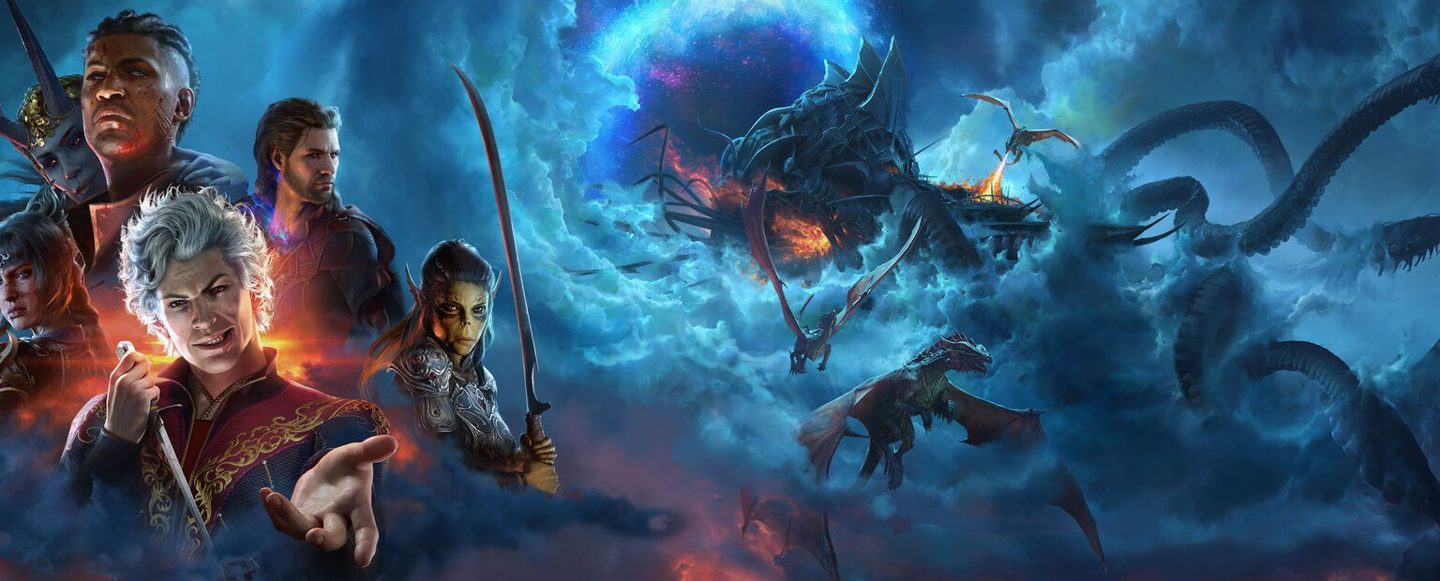
A generous, demanding RPG whose systems make room for genuinely expressive decisions.
How to read our scores ↗What works
- Rich systemic role-playing
- Expressive party and world interactions
- Strong companion-driven stakes
What to consider
- Interface and inventory friction
- A demanding rules vocabulary
- Substantial time commitment
Baldur's Gate 3 understands a valuable distinction: offering many buttons is not the same as offering meaningful agency. Its strongest moments arise when a player can recognise a situation, form an intention and discover that the game has made room for more than the most obvious response. A conversation can change the shape of a fight. A ledge can become a route rather than scenery. An apparently inconvenient spell can become the most interesting tool in the party.
That ambition is not always tidy. The same density that supports improvisation can create awkward interfaces, uncertain consequences and an overwhelming number of possibilities. Yet the game offers a compelling answer to what a large role-playing production should do with its scale. It uses breadth to support different kinds of participation instead of demanding that every player value precisely the same activity. Its appeal lies in that generosity, provided the player is willing to accept the work of understanding the systems.
A world approached through intention
Role-playing becomes convincing when a place can be read as something other than a sequence of quest markers. Baldur's Gate 3 gives exploration weight through vertical space, objects, conversations and alternate approaches. The relevant question is frequently not where to go next, but what kind of approach the party is equipped to attempt. Observing a room before entering it can be as important as finding the entrance itself.
This creates a useful relationship between character construction and the world. Skills matter because there are situations in which they can change the available options. Party members matter because different capabilities bring different interpretations of the same space. A group built only to maximise damage can still function, but it leaves some of the game's most distinctive pleasures unexplored. A party's personality emerges partly from the opportunities it notices and partly from those it decides to leave alone.
Combat as a problem with several dimensions
The turn-based structure creates room to consider positioning, resources and the order of events. Its central appeal is not slowness for its own sake. It is that a dangerous situation can be examined rather than answered only through reaction speed. A threatened companion, an elevated enemy and a concentration effect can all matter at once, but the player has time to decide which problem is most likely to make the others worse.
That makes successful planning more satisfying than a simple comparison of damage totals. A reliable attack against a strategically important target may be preferable to an impressive but uncertain one. Moving a character can be a better use of a turn than committing to the nearest enemy. The system benefits from an approach that asks what the party needs to accomplish together. Treating each character as an isolated damage source tends to obscure the more interesting relationships between actions.
Dice are meaningful because certainty is limited
Chance creates both the game's energy and some of its irritation. A plan can be sound and still fail; a desperate choice can succeed. That uncertainty prevents every encounter from collapsing into an identical solution, but it also asks players to tolerate outcomes they did not intend. The healthiest relationship with the system is not complete surrender to randomness. It is an interest in increasing the quality of the situation before asking the dice to decide it.
Advantage, sensible positioning and appropriate skills are therefore not dry technicalities. They connect preparation to outcome. A failed roll can feel unfair when it is the only visible piece of the process, but the game is more interesting when the player can recognise what was controllable beforehand. The difficulty is that those opportunities are not always obvious to a newcomer. A willingness to inspect descriptions and reconsider habits is part of the price of admission.
Companions who complicate the adventure
The companions are valuable because they have more to contribute than a combat role. Their preferences and concerns introduce friction into decisions that might otherwise become a clean optimisation exercise. A party is not only a collection of useful abilities. It is a set of people with different reasons for participating, and a successful tactical arrangement is not necessarily the same as a comfortable social one.
The writing gives that friction room to develop, though the amount of conversation will not suit every player equally. Readers who want constant control over the pace may sometimes resent a scene that interrupts an urgent objective. Others will see those interruptions as the substance of the experience. The distinction matters when recommending the game: its promise is not simply a large fantasy map, but a substantial investment in the people who travel through it and the consequences that follow them.
Freedom does not eliminate the need for clarity
Large possibility spaces are difficult to explain. A player may understand a quest's fiction while remaining uncertain about how a mechanical interaction is being interpreted. Inventory management, contextual actions and the sheer quantity of descriptions can introduce friction between having an idea and executing it. That friction is not automatically a charming sign of depth. It is a genuine usability cost, especially when several party members and numerous items need attention.
The game is best approached with permission to simplify. It is not necessary to understand every class combination before leaving the opening area. A balanced party with clear jobs can reveal the underlying structure more effectively than an elaborate build assembled from unfamiliar terms. Our early-game party guide takes that approach. It prioritises understanding the next meaningful decision over preparing for a hypothetical perfect endgame character.
Failure can support role-playing, but not every reader enjoys it
There is a persuasive argument for allowing an unexpected result to stand. A failed conversation check may create a distinctive version of an adventure rather than a broken one. Yet that argument should not become a moral judgement about saving and reloading. Different players have different reasons for seeking a particular outcome, and limited leisure time can make an unwanted detour feel less like an entertaining story than an expensive misunderstanding.
What matters is knowing which experience is being chosen. Treating every roll as reversible can turn conversation into a search for the preferred branch. Accepting more outcomes can create a story with less certainty and more surprise. Neither approach erases the value of the other. Baldur's Gate 3 earns credit for supporting a world interesting enough to make that discussion worth having, even though the player must still decide how much unpredictability is enjoyable.
The size of the game is both strength and qualification
The scale allows different systems to meet in surprising ways, but it also demands memory and continuity. Returning after a long break can involve remembering relationships, equipment and the reason a route seemed important. Players who enjoy a campaign spread across many sessions may appreciate that accumulation. Those who prefer a compact experience with a clear stopping point should understand that the same abundance can become an obligation.
There is also a difference between substantive choice and the anxiety of missing content. A game that rewards curiosity can encourage the belief that every overlooked corner represents a mistake. That is a poor foundation for enjoying an adventure this expansive. A more rewarding expectation is that a particular party will experience a particular journey. The richness of the world should make that journey feel supported, not make every alternative feel like unpaid homework.
What Patch 8 changes about the recommendation
Larian's Patch 8 added cross-play, Photo Mode and twelve subclasses as its final major content update. Those additions broaden ways to play and document an adventure, but they do not change the central recommendation. The essential appeal remains the relationship between role-playing choices, party capabilities and a world that often acknowledges an inventive approach. New subclasses are most valuable when they offer a different way to engage with that relationship rather than simply a larger menu.
Cross-play also gives an existing social group more reason to investigate whether a shared campaign is practical. It does not remove the logistical work of keeping a long cooperative story together. Agreeing on pace, dialogue decisions and how to handle absent players matters as much as technical compatibility. Our Patch 8 briefing examines those additions as opportunities with practical qualifications, rather than as a reason to promise an effortless multiplayer experience.
A score needs a reader attached to it
For players who value improvisation, complex companions and a campaign that rewards paying attention, Baldur's Gate 3 is an unusually strong proposition. For those who dislike reading rules, organising inventories or dealing with uncertain outcomes, its achievements may not outweigh its demands. Calling it an exceptional RPG should not imply that every reader ought to find the same balance appealing. The more honest recommendation explains both the possibility and the effort.
Its lasting importance is the confidence with which it allows different systems to share a world. Combat is not sealed off from conversation; character construction is not sealed off from exploration. At its best, the game makes preparation feel expressive and a surprising outcome feel like part of an adventure. That is a substantial accomplishment, even when the machinery supporting it becomes visible and requires patience.
The verdict
Baldur's Gate 3 offers the pleasure of taking an idea seriously and discovering how far the world is prepared to follow it. Deep systems, expressive party construction and complicated companions give decisions a texture that spectacle alone cannot provide. Its usability friction and considerable commitment remain important qualifications. The recommendation is strongest for readers who want to participate in a dense fantasy world, not simply move through an expensive one.
Pros – Exploration, conversation and combat inform one another. – Party capabilities give role-playing choices practical consequences. – Companions provide personal stakes beyond the next objective.
Cons – Inventory and interface management can interrupt the adventure. – Complex rules and uncertain outcomes require patience. – A long campaign can be difficult to resume after an extended break.
Recommended audience: players seeking an expansive, systems-rich fantasy RPG and willing to learn its vocabulary. NTRW score: 9.5/10. This is a critical design assessment; platform-specific frame-rate testing is not part of this review.
References and further reading
Larian's official game overview explains the role-playing and combat framework. The Patch 8 release notes document the final major content update. For a gentler first campaign, use our Act One decision guide.
What is your perspective?
Share a useful observation. Keep spoilers clearly signposted and follow our community guidelines.