
An exacting platformer whose clear movement and compassionate design make persistence meaningful.
How to read our scores ↗What works
- Expressive precise movement
- Excellent teaching through level design
- Thoughtful accessibility options
What to consider
- Precision can be tiring
- Optional goals can feel overwhelming
- Narrower appeal beyond platforming fans
Celeste makes a useful distinction between a difficult task and a hostile game. Its mountain can be demanding, but the design repeatedly invites you to try again. A missed jump usually leads to another attempt quickly enough that the mistake remains understandable. The result is a platformer where persistence feels less like enduring punishment and more like refining an idea. Difficulty is part of the conversation, rather than the game's only subject.
The story follows Madeline's climb and gives emotional context to that repeated effort. It does not need every obstacle to operate as a literal symbol. The connection emerges through rhythm: hesitation, commitment, failure and another attempt. Celeste is unusually good at making a mechanical improvement feel personal without suggesting that a video game can neatly resolve the complicated feelings it depicts. That balance gives its precision a humane purpose.
A small vocabulary with a long expressive range
Running, jumping, climbing and an air dash establish a concise movement language. The challenge comes from how a room arranges those actions, not from continuously adding commands. A simple gap can become a question of position, momentum and direction. Because the vocabulary remains legible, a failed attempt often produces a useful answer: jump later, aim the dash differently, or save an action for the second half of the route.
This clarity allows a room to feel like a compact argument. Its opening position offers information; its hazards test an assumption; its exit confirms whether the plan worked. Not every solution is obvious, and execution remains demanding even after the route is understood. Yet the relationship between planning and movement is close enough that success rarely feels disconnected from what you learned during previous attempts.
Fast retries preserve the lesson
The brief distance between failure and another attempt is central to the experience. A difficult sequence can become discouraging when each mistake demands a long return journey. Celeste largely keeps the question in front of you. That makes experimentation more affordable. Trying an unfamiliar line through a room does not usually require sacrificing a large block of otherwise successful play.
Fast retries are not the same as effortless progress. Repetition can still become tiring, particularly when a room demands a movement you have not yet internalized. The design's generosity lies in reducing unrelated friction. You spend more of the session considering the jump and less of it proving that you can reach the jump again. That distinction matters enormously in a game built around precise, repeated action.
Rooms teach before they combine
Celeste's environments tend to introduce ideas in a readable context before asking for a more complex sequence. The room itself becomes instruction. A safe surface, a visible exit or a newly introduced object directs attention without always stopping play for a lengthy explanation. Later challenges ask you to combine the same ideas with less room for indecision. The learning curve is not smooth for every player, but its logic is usually visible.
The best sequences feel like fluency rather than memorization alone. You recognize the next movement while finishing the current one. That is a powerful reward because it changes your relationship with a space that originally looked intimidating. A room does not become smaller; your understanding becomes more efficient. Our beginner movement guide offers a deliberate route into that vocabulary without relying on advanced techniques.
Optional challenges change the meaning of completion
Collectibles and additional challenges give confident players reasons to revisit an area. Their presence also asks a quieter question: must every visible challenge be completed before you are allowed to move on? Celeste is more enjoyable when you can answer that question for yourself. An optional objective should be an invitation, not an obligation inherited from the map.
There is considerable satisfaction in taking a more demanding route once the basic movement feels secure. There can also be value in leaving it for later. The game's broader design supports the idea that reaching the next part of the journey counts as progress. Players who habitually pursue total completion on a first run may need to create that permission explicitly. The mountain contains more than one reasonable measure of success.
The narrative earns its place beside the mechanics
Madeline's story gives the climb a perspective that pure mechanical escalation would lack. Conversations create pauses, while moments of uncertainty connect the demanding route to a person with reasons to continue. The writing is most effective when it allows vulnerability to coexist with humour and frustration. The protagonist is not interesting simply because she can persevere indefinitely.
The emotional framing also makes the game's patience feel coherent. A quick restart is a practical convenience, but within this story it becomes part of an encouraging attitude toward struggle. The design does not demand that every reader interpret the narrative identically. What matters is that the emotional and mechanical rhythms support each other. Both recognize that progress can involve repetition without being reduced to repetition.
Assist Mode expands the invitation
Assist Mode is an important part of Celeste's design identity. It offers ways to adjust the experience for players whose needs or preferences differ from the default challenge. That flexibility does not make the original tuning meaningless. It acknowledges that the relationship between a person and a demanding input sequence is not identical for everyone. Access and mastery are related questions, but they are not the same question.
The practical value depends on choosing adjustments that solve your particular obstacle. A player learning the route may want a different kind of support from someone managing fatigue or input difficulty. There is no need to treat assistance as a moral verdict on the player. Check the options in your installed version and experiment with a setting that makes the next attempt useful. Returning to a room with a better configuration is still engaging with the game.
Presentation makes the mountain feel larger
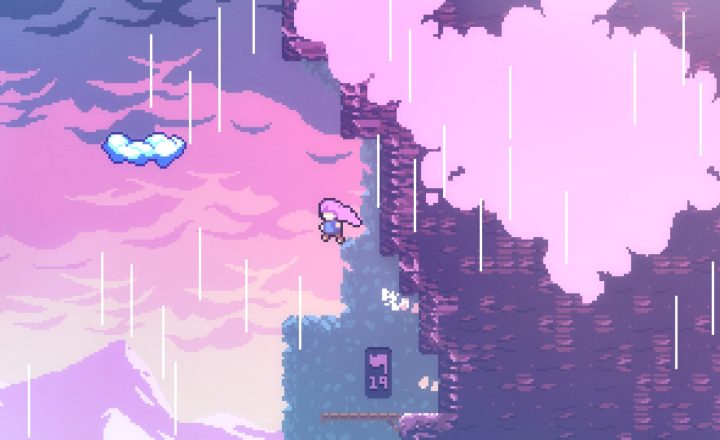
The pixel art provides strong silhouettes and readable spaces without flattening the setting into a diagram. Backgrounds suggest distance and changing weather, while animation makes movement feel lively. The visual contrast between a small character and a large environment reinforces the climb's emotional scale. Importantly, the spaces still communicate enough information for precise play to remain the centre of attention.
Music carries a significant part of the atmosphere. Its shifts support concentration, urgency and relief without needing the action to become cinematic in a conventional sense. The presentation works because it understands that a small room can contain an enormous emotional change. An exit reached after repeated attempts may be visually modest, but the sound and pacing give that arrival room to register.
Where the climb can become exhausting
Celeste's greatest strength can also limit its audience. It asks you to care about exact movement, sometimes through many attempts at a short sequence. Players who prefer broad exploration or systemic experimentation may find that focus restrictive. The story provides context, but it does not transform the central activity into something other than a precision platformer. Enjoyment still depends on some appetite for practicing movement.
Fatigue is another important consideration. A sequence that teaches clearly at the start of a session can feel unreadable once attention begins to slip. Fast restarts can make it easy to continue longer than is useful. Taking a break is often a better response than treating every immediate retry as evidence of determination. The design provides opportunity; the player still benefits from deciding when to use it.
Controls deserve deliberate attention
Because small directional decisions matter, the input device and configuration deserve a few minutes of setup. Choose a layout that lets you perform frequent actions comfortably. Test whether diagonal movement and dash directions feel predictable. That process is more useful than assuming a particular controller, keyboard or grip is universally best. A setup that another player loves may not suit your hands or habits.
This review does not present a fresh input-latency test or claim performance parity across editions. The design assessment concerns the game's core movement, structure and accessibility approach. Before purchasing for a specific device, check current compatibility information and recent reports relevant to that configuration. A demanding game benefits from a comfortable setup, but its editorial value should not be confused with an unperformed technical benchmark.
Verdict: precision with perspective
Celeste succeeds because it understands why another attempt can be appealing. Clear movement, compact challenges and quick retries turn mistakes into information. The narrative then gives that process emotional context without overwhelming the platforming. It is an unusually coherent work: the story's compassion and the mechanics' patience point in the same direction, even while the default challenge remains demanding.
The intensity will not suit every player, and optional challenges can become a source of unnecessary pressure if treated as compulsory. Even so, the combination of elegant movement and thoughtful flexibility makes Celeste an outstanding recommendation for anyone curious about the form. It respects the pleasure of mastery while leaving room for different ways of reaching the summit.
Pros – Exceptionally clear movement and compact level design. – Quick retries keep attention on the problem being learned. – Story, music and accessibility options support a compassionate tone.
Cons – Repeated precision sequences can become exhausting. – Optional completion goals can overwhelm newcomers. – Its focused structure offers limited appeal to players who dislike movement practice.
Recommended audience: platforming fans, players interested in learning precise movement, and readers who value thoughtful accessibility choices. NTRW score: 9.4/10. This is a critical design judgement, without a claim of a newly completed hardware or performance test.
References and further reading
The official store description outlines the movement-based climb and additional challenges. The developer's change log records options and updates. For a related exploration of learning through repetition, read our Hades review.

What is your perspective?
Share a useful observation. Keep spoilers clearly signposted and follow our community guidelines.