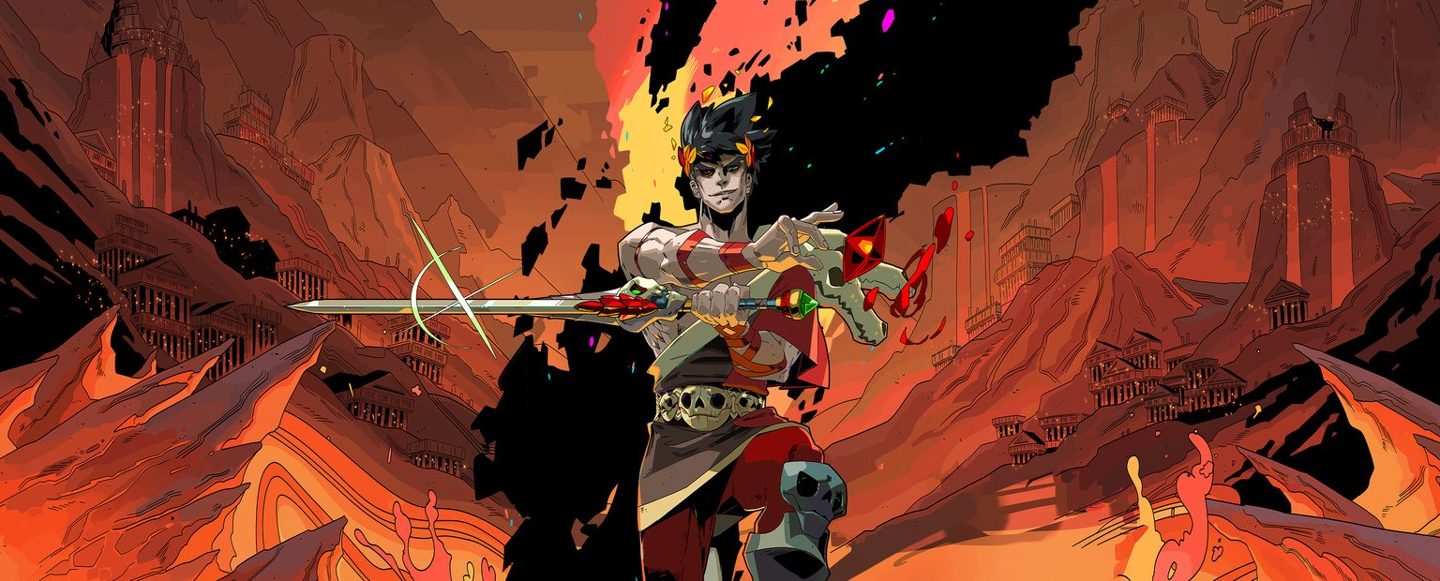
A remarkably coherent action game that makes the return trip matter as much as the escape.
How to read our scores ↗What works
- Exceptionally coherent narrative loop
- Expressive weapons and build choices
- Persistent progress supports learning
What to consider
- Repeated regions are integral
- Effects can become visually dense
- Real-time action demands remain
The most convincing thing about Hades is not the promise that the next run will be different. Plenty of roguelikes can make that promise. It is the sense that the next run will belong to the same ongoing story. Zagreus returns to a household that remembers him, carries an argument that has not finished, and meets people whose relationships stretch beyond a successful room clear. Repetition becomes a way of understanding a place rather than merely a condition imposed by the genre.
That difference gives the game unusual coherence. Its action systems want experimentation, its fiction wants return visits, and its progression makes an unsuccessful attempt useful without pretending that every defeat is a victory. The result is an action game that can welcome an imperfect run while still demanding attention from anyone trying to escape. Hades deserves its reputation because those layers reinforce one another instead of competing for time.
Combat that gives each decision a shape
The foundation is readable, immediate action. An attack, a special, a cast and a dash create a small vocabulary, but the relationship between them changes with the weapon and the blessings collected along the way. A close-range weapon makes personal space a pressing concern; a ranged option makes lines of fire and recovery windows more important. The interesting distinction is not simply how much damage a weapon deals. It is where that weapon asks its player to stand.
Good combat options also produce understandable mistakes. Moving into a crowded corner, spending a defensive movement without an exit, or chasing one more hit explains a loss more clearly than an invisible calculation does. Hades is strongest when a dangerous room can be read as a sequence of decisions. Learning to leave a position before it collapses is as meaningful as learning which upgrade makes a favourite attack stronger. Build knowledge supports that lesson; it does not replace it.
A build is an argument, not a shopping list
The gods' boons make a run feel authored without allowing complete control. A player may prefer a particular combination, yet the available choices ask a more useful question: what can this run become with what is actually here? The difference between a cohesive build and a collection of attractive effects is central to the game's appeal. Complementary choices create a plan. Disconnected choices create a loadout that is harder to understand when pressure rises.
That is why the upgrade system works as more than a novelty generator. A strong combination changes priorities in a room, which enemies feel urgent and which actions deserve commitment. It can encourage aggressive movement or a more deliberate rhythm. The best discoveries are not necessarily the rarest ones. They are the moments when an effect clarifies the rest of the kit. A familiar weapon suddenly asks for a different kind of judgement, and a previously unappealing option earns a second look.
Storytelling built around the return trip
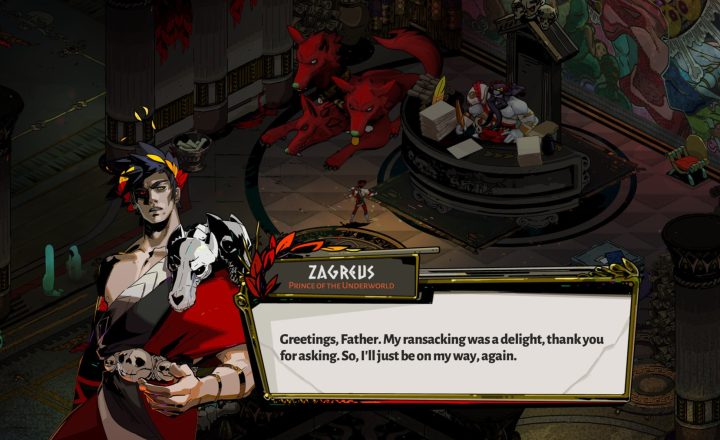
Hades treats its home base as an essential part of the action loop. A return is an opportunity to hear a response, notice a developing relationship or revisit an unresolved disagreement. That gives failure an emotional texture that a conventional restart screen cannot provide. The characters are not merely rewards distributed between fights. They help establish why the attempt matters and why stopping after a difficult run can still feel like leaving something unfinished.
There is a productive tension in that structure. Progress through the narrative does not perfectly match progress through the Underworld. A player interested mainly in the story may sometimes feel held at the gate by combat; an action-focused player may want the next fight sooner. But the game earns much of its character from refusing to separate the two completely. The household makes the battles more personal, while the repeated battles make the household's conversations feel grounded in a shared history.
Progression without the illusion of effortless mastery
Persistent development softens the cost of an unsuccessful run, but it does not remove the need to recognise threats. That balance matters. If permanent upgrades solved every problem, a difficult encounter would become a request to repeat easier content until the numbers improved. If nothing survived, an early failure could feel disconnected from the larger experience. Hades places material progress beside practical learning, allowing each to support the other without treating them as the same accomplishment.
The distinction is useful for newcomers. Improving a character can create more room to practise, but the crucial advances often happen outside a menu: understanding a wind-up, noticing a projectile lane or choosing not to attack. Our first-escape guide focuses on that relationship. A sensible upgrade plan helps most when it buys opportunities to make better decisions. It is less useful when it encourages the belief that an unfamiliar boss can be ignored until a particular blessing appears.
Presentation with a strong editorial eye
The visual style has an important practical job. Characters need to remain distinctive against elaborate backgrounds, attacks need to communicate danger, and rewards need to invite a quick reading. Hades combines expressive character art with a theatrical sense of place, but its strongest visual achievement is hierarchy. The work does not stop at making a room look rich. It also directs attention toward what a player needs to interpret while that room is becoming dangerous.
The music contributes a comparable sense of identity. Its force is not just a matter of making combat louder or faster. It gives the journey momentum and helps the setting feel specific rather than generically mythological. A soundtrack can become exhausting when it demands constant foreground attention; the more interesting achievement is how musical energy and quieter returns establish contrast. The game's dramatic personality survives because it has somewhere to relax as well as somewhere to erupt.
Where repetition starts to push back
The structure has limits, and those limits will matter differently to different readers. Repeated regions and familiar encounter patterns are part of the design rather than incidental padding. A player who values constant environmental novelty may find that the changing build does not fully answer the desire for new places. The game provides variation within a recognisable journey, not an endlessly expanding catalogue of completely separate adventures.
Its density can also become a barrier. When several effects are active, judging the most immediate danger is harder than understanding a clean demonstration of a mechanic. A strong run may begin to feel defined by an exceptional combination, making a more ordinary attempt less exciting by comparison. Neither issue invalidates the system, but both complicate the suggestion that every run is equally rewarding. Some attempts are valuable because they teach restraint, not because they deliver a spectacular new discovery.
Accessibility and the question of a satisfying challenge
Hades includes God Mode, an option designed to make survival more forgiving while allowing the story and broader systems to remain relevant. Its presence is valuable because enjoying repeated attempts does not require everyone to accept the same margin for error. The important question is whether the chosen level of support leaves enough meaningful decisions to make a run engaging. Difficulty that encourages attention can be productive; difficulty that repeatedly closes the door on the entire experience is not automatically virtuous.
That does not make Hades a quiet game. It still asks players to process motion, overlapping information and quick decisions. Someone looking for a relaxed narrative experience should consider those demands rather than treating its attractive characters as a guarantee of comfort. Someone who likes action but dislikes losing all sense of forward motion is a much clearer match. The support options widen that match, but the underlying rhythm remains one of pressure, release and return.
Who should play Hades?
Hades is an excellent recommendation for players who enjoy learning a compact system in depth. It suits people who like a familiar framework with shifting tactical possibilities, and those who appreciate character writing that grows through repeated contact. It is a less straightforward choice for players who want a single uninterrupted campaign, abundant freedom to explore at a gentle pace or a game that changes its basic demands whenever an encounter becomes difficult.
It also offers a useful entry point into understanding why the roguelike structure persists. A run is not only a disposable attempt at a final objective. It is a container for a particular set of decisions, and losing that container can make the next one more legible. Hades gives that idea warmth and personality. Failure becomes bearable because something survives it, and success becomes meaningful because the game never entirely disguises what had to be learned.
The verdict
Hades brings unusually strong agreement between what its story says and what its systems ask the player to do. Its combat rewards a developing sense of space, its upgrades invite practical experimentation, and its characters turn recurrence into continuity. Repetition and visual density remain real qualifications, particularly for anyone who wants novelty without repeated routes. For players willing to meet it on its own terms, however, the design has a clarity that few action games sustain across so many attempts.
Pros – Combat, progression and character relationships serve the same central loop. – Weapons and boons change tactical priorities rather than merely adding numbers. – Unsuccessful attempts can produce both practical learning and narrative movement.
Cons – Familiar regions remain a significant part of repeated play. – Busy combinations can make immediate threats harder to read. – Narrative curiosity does not remove the demands of real-time combat.
Recommended audience: action players who enjoy experimentation, character-led stories and gradual mastery. NTRW score: 9.3/10. The score expresses our critical assessment of the design; it is not a platform benchmark or an aggregate of other publications.
References and further reading
The official Hades page establishes the premise and core feature set. For the sequel's separate release history, see the official Hades II FAQ. Continue with our roguelike learning framework for a wider look at how repeated attempts support mastery.
What is your perspective?
Share a useful observation. Keep spoilers clearly signposted and follow our community guidelines.