
A richly connected kingdom where learning the map is as rewarding as learning the fight.
How to read our scores ↗What works
- Purposeful interconnected exploration
- Elegant and expressive combat
- Cohesive visual and audio identity
What to consider
- Backtracking can wear thin
- Recovery runs add friction
- Deliberately fragmentary storytelling
Hollow Knight makes a persuasive case for the pleasure of being a little lost. Hallownest is not compelling because it conceals every answer. It is compelling because its spaces invite the player to notice, remember and connect them. A locked route, an unfamiliar sound or a place glimpsed from the wrong side can become a reason to return. Discovery feels like a change in the player's understanding, not merely the arrival of another marker on a map.
That approach gives the game its atmosphere and its most significant qualification. It expects curiosity to survive inconvenience. The player who enjoys holding an unresolved route in mind may find the world wonderfully absorbing; the player who needs constant confirmation of forward progress may find the same structure exhausting. Hollow Knight is not neutral about exploration. It makes a clear argument that uncertainty can be part of the reward, then asks its combat and geography to justify that belief.
Geography that carries a story
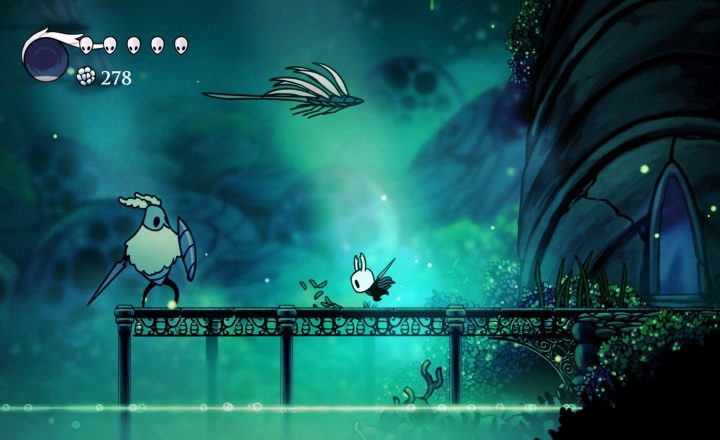
The ruined kingdom feels connected through more than doors. Changes in texture, architecture and sound establish a sense of moving between places that once had different purposes. That distinction is important in a large interconnected world. An area needs an identity so that returning to it can involve recognition rather than a fresh reading of interchangeable scenery. Hallownest gives memory something useful to hold.
The world is also willing to remain quiet. It does not explain every relationship at the moment it becomes relevant, and it lets curiosity develop before providing context. This restraint gives discoveries room to feel personal. It can also make the story difficult to follow if a player wants a clearly delivered sequence of revelations. The environmental approach is strongest for readers who enjoy assembling a picture from suggestive fragments rather than receiving a complete interpretation on arrival.
A small combat vocabulary with considerable depth
The core actions are easy to name: move, jump, strike, cast and find a safe moment to recover. Their value comes from timing and commitment. A simple attack remains interesting because its usefulness depends on distance, enemy behaviour and the route available after contact. The game does not need a large list of commands to make a dangerous position feel different from a manageable one.
Healing is especially important to that relationship. Recovery is not merely a menu action performed when convenient; it asks for space and a window in the encounter. That gives defensive decisions a constructive purpose. Avoiding damage is useful, but understanding when it is possible to recover can be equally significant. Boss knowledge therefore includes more than identifying attack patterns. It includes recognising where the fight briefly relaxes and what can safely be done with that moment.
Mobility changes the meaning of familiar rooms
New movement abilities work best when they make earlier geography intelligible in a new way. A gap once read as a boundary can become an invitation, and a vertical passage can change from background scenery into a practical route. Hollow Knight's world supports that kind of reinterpretation. Progress is not always represented by entering a completely new place; it can mean returning to an old one with a more capable vocabulary.
That structure also creates a risk of unnecessary repetition. Backtracking feels purposeful when the player remembers a possibility and can test it. It feels less rewarding when the journey is being repeated mainly to confirm that the wrong route was chosen. The distinction will depend partly on patience and partly on how clearly the game communicates its spaces. Hallownest often earns the return trip, but the existence of a shortcut is more satisfying after it is found than before it is understood.
Mapping as part of the adventure
Purchasing mapping tools and establishing a relationship with the map makes navigation an activity rather than a service that arrives complete. That decision helps support the world's atmosphere. The player is not simply watching a location update in real time; they are gradually learning a place and assembling ways to keep track of it. Uncertainty becomes a resource the game can spend.
The cost is that a basic convenience can feel withheld. Someone already frustrated by the distance between safe points may not welcome another obstacle to orientation. That objection should not be dismissed as a failure to appreciate exploration. The mapping system expresses a particular design preference, and it works best when the player is willing to share that preference. Our early exploration guide offers a proposed route while preserving room to investigate, rather than turning the kingdom into a compulsory checklist.
Charms encourage a personal relationship with risk
Charms give players a way to emphasise an approach without replacing the fundamental demands of combat. A loadout can support a preference, but it still needs to meet the circumstances of an encounter. The interesting question is not which collection looks strongest in isolation. It is whether the chosen effects support the way a particular player is actually moving, attacking and recovering.
That makes experimentation valuable even when it is not dramatic. A modest adjustment can make a familiar fight easier to interpret, while an ambitious setup can fail because it encourages habits the player has not yet learned. The system creates a bridge between character preparation and practical skill. It is most rewarding when treated as a means of asking better questions about an encounter, not as a hidden answer that makes the encounter's lessons unnecessary.
Difficulty with an atmospheric consequence
Danger is part of what gives the world weight. A difficult return route can make a bench feel like a discovery rather than a routine checkpoint, and a threatening enemy can change how a corridor is remembered. The game benefits from those emotional associations. Its places matter partly because the journey through them is not entirely assured.
Yet difficulty has a cumulative cost. A boss can be interesting while the repeated route to that boss becomes tiresome. Losing resources can sharpen attention, but it can also encourage a cautious recovery trip at the precise moment a player wants to experiment. Hollow Knight's punishment systems do not affect everyone in the same way. Readers should consider not only whether they enjoy challenging fights, but whether they enjoy the exploration and recovery structure surrounding those fights.
Art direction that leaves room for interpretation
The hand-drawn presentation gives characters strong silhouettes and the world a particular melancholy. The small scale of the protagonist against imposing spaces helps communicate vulnerability without constant explanation. Creatures can be charming, strange and threatening within the same visual language, which gives the kingdom continuity even when its regions are sharply differentiated.
The art is also willing to suggest more than it confirms. Background detail can imply a larger world without converting every object into an entry in an encyclopedia. That economy supports exploration: the player has room to wonder rather than being told exactly how each discovery should feel. It is a useful reminder that environmental storytelling does not become richer simply by increasing the quantity of text available to explain it.
Sound, silence and the pace of a journey
Hollow Knight's soundscape helps distinguish a difficult journey from a constant alarm. Music and ambient cues give spaces a mood, while changes in intensity can make an encounter feel like an event. The effectiveness lies in contrast. A world that is always declaring its importance can become difficult to inhabit; a world that sometimes leaves room for quiet can make a new sound genuinely inviting.
That restraint also supports the game's pacing. A period of searching can prepare the player for a more concentrated challenge, and a newly opened connection can release tension accumulated over several uncertain rooms. Not every player will find the intervals equally engaging. But the rhythm makes the kingdom feel like a place with distances and moods, rather than a corridor of demanding fights separated only by loading time.
Who should enter Hallownest?
The strongest recommendation is for players who enjoy learning a world as well as learning a combat system. Hollow Knight rewards a memory for places, an interest in unresolved routes and the willingness to return to a challenge with a more precise plan. It suits readers who find atmosphere in restraint and who do not need a story to explain all of its mysteries immediately.
It is a more qualified choice for players who dislike backtracking, uncertain navigation or the repetition surrounding a hard encounter. A beautiful world does not make those preferences disappear. Nor does an enthusiastic recommendation require a reader to finish every optional challenge. There is value in knowing which parts of the structure are appealing before committing to the whole journey. The game offers depth, but depth is useful only when its particular demands are interesting to the person exploring it.
The verdict
Hollow Knight makes attention feel like a form of progression. Its interconnected geography, economical combat and distinctive atmosphere combine into a world that becomes richer as it becomes more familiar. The cost of that coherence is a willingness to revisit routes and tolerate uncertainty, sometimes alongside demanding fights. For players who share its curiosity, Hallownest offers an unusually convincing sense that discovering a place and learning how to survive it are part of the same achievement.
Pros – Interconnected places reward observation and memory. – A compact combat vocabulary supports meaningful tactical decisions. – Art direction and sound establish an unusually coherent atmosphere.
Cons – Navigation and backtracking can become tiring. – Repeated recovery routes may interrupt experimentation. – The fragmentary story will not satisfy every reader's preference for clarity.
Recommended audience: exploration-focused action players who enjoy demanding encounters and a world that leaves room for interpretation. NTRW score: 9.1/10. The judgement focuses on design and player fit, rather than a new technical benchmark.
References and further reading
Team Cherry's official Hollow Knight description documents its interconnected setting, Charms and movement progression. Our early-route guide suggests how to start without treating that suggestion as the only valid order. For another kind of mastery, read our Celeste review.

What is your perspective?
Share a useful observation. Keep spoilers clearly signposted and follow our community guidelines.