
A generous life simulation whose best reward is the freedom to define a satisfying day.
How to read our scores ↗What works
- Flexible personal goals
- Satisfying visible progression
- Memorable seasonal atmosphere
What to consider
- Calendar pressure can surprise
- Repetitive early chores
- Uneven delivery of useful information
Stardew Valley begins with an appealing promise: leave an exhausting routine behind and build something that belongs to you. Then it immediately hands you a different routine. Crops need water, tools need upgrading, shops have opening hours, and the day keeps moving while your plans compete for attention. The trick is that this second routine can become yours to shape. Stardew Valley is most convincing when its systems invite a personal rhythm, rather than when they resemble a spreadsheet asking to be solved.
Its farming, relationships, fishing and exploration support one another without requiring every player to value them equally. That flexibility is the foundation of its lasting appeal. You can chase efficient production, make a welcoming farm, learn the town's habits or alternate between all three. The freedom is substantial, although the game does not always explain its limits gently. A missed season or an inconvenient shop closure can feel surprisingly sharp inside such a warm world.
A farm with competing possibilities
The early farm is an exercise in choosing what deserves your energy. Clearing every obstacle looks productive, but it may leave little strength for planting or exploring. Expanding crops increases income potential while also increasing the time spent watering. These are readable trade-offs. A field becomes a visible record of your ambitions, and an overgrown corner can become a reminder that not every available task needs to be completed immediately.
This relationship between layout and routine gives the farm character. A perfectly efficient arrangement can be satisfying, but so can a small orchard beside a path that exists simply because you like the view. Stardew Valley allows these priorities to coexist. Its progression provides machinery and infrastructure that gradually loosen the daily burden, giving you space to reconsider what you actually want to do with the time you have gained.
The calendar is both structure and pressure
Seasons stop farming from settling into one indefinite pattern. A crop that makes sense now may be useless to plant near the end of the month. Birthdays and festivals make dates matter beyond the field. The calendar creates anticipation, but it can also punish an understandable assumption that a relaxed-looking game will wait patiently for you. Players who dislike missing opportunities may find themselves checking guides more often than they expected.
The healthiest response is to treat the first year as learning rather than a final examination. Most ambitions can survive an imperfect schedule. That does not erase the frustration of losing crops to a seasonal transition, but it changes the scale of the setback. The game works better when a bad harvest becomes part of the farm's history instead of evidence that the entire save has failed. Our first-spring guide explains the basic timing without prescribing every hour.
Small decisions become a recognizable routine
Watering crops is not an exciting action in isolation. Its value comes from context: the field you chose, the money you hope to earn, the upgrade that might shorten tomorrow's work. Repetition makes improvements legible. A better tool or a newly automated area means more because you understand the labour it replaces. Progress changes how the day feels, rather than merely increasing a number on a menu.
There is a corresponding risk. If every purchase becomes another reason to expand, the farm can turn into the kind of obligation the opening seems to reject. Stardew Valley gives you permission to slow down, but it rarely forces that permission into the foreground. Players must sometimes defend their preferred pace against their own instinct to optimize. That tension is interesting, even when it becomes tiring.
Pelican Town gives the schedule a human dimension
The town is not just a supply depot. Residents have routines, preferences and concerns that make repeated visits feel more meaningful. Familiarity develops through small encounters and gradually revealed stories. The writing is strongest when ordinary habits suggest lives that continue outside your immediate attention. A shopkeeper being unavailable can be inconvenient mechanically while still making the place feel less like a collection of service counters.
Relationships also expose the boundaries of the simulation. Gifts and repeated interactions can become transactional if you approach them purely as a meter to fill. Looking up an ideal present may be efficient, but it can flatten the experience of discovering a person's taste. The game supports both approaches. Its emotional effect depends partly on whether you allow characters to be neighbours before treating them as objectives.
A useful change of activity is always nearby
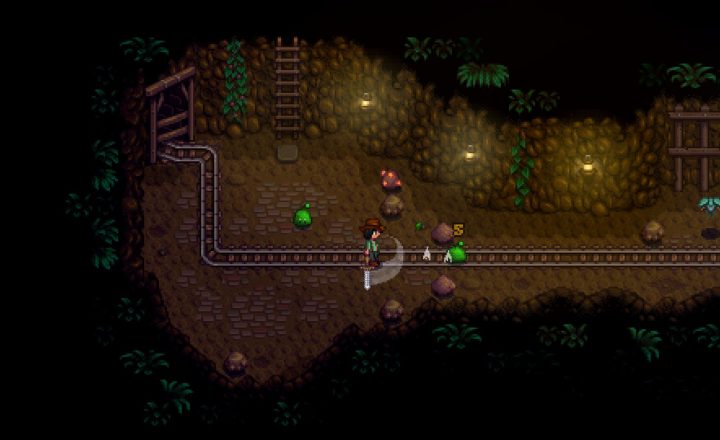
The mine offers a different kind of pressure from the farm: preparation, navigation and combat inside a limited outing. Fishing asks for a more focused physical rhythm. Foraging encourages you to notice a route rather than race through it. These activities prevent the farming loop from carrying the entire experience alone. A day can feel productive even when the field is not the main event.
Not every activity will appeal equally. Fishing can be a particular sticking point for players who enjoy the planning systems but dislike its execution demands. Mining can feel more like an interruption than an adventure if combat is not your preference. The important design choice is that you can adjust the balance of your routine. The game is broad enough to accommodate distinct priorities, though some progression goals still encourage activities you may not love.
Progression makes ordinary objects memorable
Stardew Valley understands the appeal of a modest milestone. A repaired space, a useful machine or a carefully arranged room can carry more emotional weight than a spectacular reward detached from daily play. The objects matter because they sit inside a familiar environment. You return to them, rely on them and notice how they change your route. Progress becomes domestic and visible.
The breadth of crafting and collection can occasionally make the next step unclear. A resource may seem unimportant until a recipe suddenly demands it. Discovering connections is part of the pleasure, but storage and information management can become work of their own. A few personal rules for keeping supplies will do more for a relaxed playthrough than memorizing every profitable strategy before the first seed goes into the ground.
A gentle aesthetic with real emotional range
The pixel art is effective because it makes spaces easy to recognize while leaving room for imagination. Seasonal changes alter the mood of familiar paths. Interiors and outdoor areas have enough detail to invite attachment without making basic navigation difficult. The presentation does not need cinematic realism to make a farm feel inhabited. Repetition strengthens the visual identity instead of exhausting it.
Music and ambient sound reinforce that sense of place. Their contribution is not simply comfort; a change in atmosphere can make a routine journey feel newly reflective. The strongest impression is of a world large enough to contain more than your immediate objective. That makes the player's quieter decisions feel legitimate. Decorating, walking or spending time with a familiar resident can belong to the experience without needing a maximum-efficiency justification.
Multiplayer changes the social contract
Cooperative play introduces an additional question: whose pace is the farm following? Shared responsibilities can reduce repetitive work and make a communal project feel lively. They can also create friction when one person wants to explore and another wants every day planned around production. The systems do not automatically solve that disagreement. A conversation about priorities is as useful as a better layout.
Platform features and multiplayer arrangements should be checked for the edition you intend to buy. This review is a design assessment, not a fresh compatibility test across devices. The existence of multiple releases does not imply that every configuration, modification or control scheme behaves identically. For the same reason, a friend's excellent experience with one setup is useful context rather than a guarantee for all others.
What the expanded game asks of a newcomer
The appeal of a mature game with many additions is obvious: there is a great deal to discover. The cost is a growing field of possible distractions. Newcomers benefit from a small set of immediate goals rather than a complete catalogue of everything added over the years. A first crop, a manageable routine and a few useful routes provide a better foundation than a checklist copied from an experienced player's final farm.
Long-term players may enjoy the added variety precisely because they already understand the basics. Those two audiences do not need the same advice. Stardew Valley's depth is best encountered in layers. The game can support a remarkable number of projects, but its opening remains more enjoyable when you accept that most of them can wait. A sense of ownership matters more than a flawless first season.
Verdict: a rewarding life, provided you choose its pace
Stardew Valley turns an ordinary cycle of work, exploration and relationships into a persuasive framework for personal goals. Its strongest quality is not unlimited freedom; the calendar and energy systems impose clear constraints. It is the variety of meaningful decisions you can make inside those constraints. A productive day can mean money, a new route, a better room or a conversation you wanted to have.
The friction is real. Seasonal deadlines can surprise, early routines can become repetitive, and information is not always delivered at the moment you need it. Yet those limits rarely erase the pleasure of shaping a place over time. Players who enjoy gradual progress and self-directed projects will find an unusually accommodating world. Players seeking constant narrative urgency may find its generosity less compelling.
Pros – Flexible goals support very different styles of play. – Visible improvements give everyday routines satisfying meaning. – Town life and seasonal presentation create a strong sense of place.
Cons – Calendar mistakes can be frustrating for newcomers. – Early chores can dominate a session. – Some useful information requires experimentation or outside reference.
Recommended audience: players who enjoy farming, life simulation, collection and patient creative projects. NTRW score: 9.2/10. This score reflects editorial judgement of the game's design, not a new performance test or a claim that every platform offers an identical experience.
References and further reading
The official Stardew Valley site provides release information, while the community-maintained crop reference explains seasonal growth rules. Read our console and mobile update briefing for the dated release context.

What is your perspective?
Share a useful observation. Keep spoilers clearly signposted and follow our community guidelines.